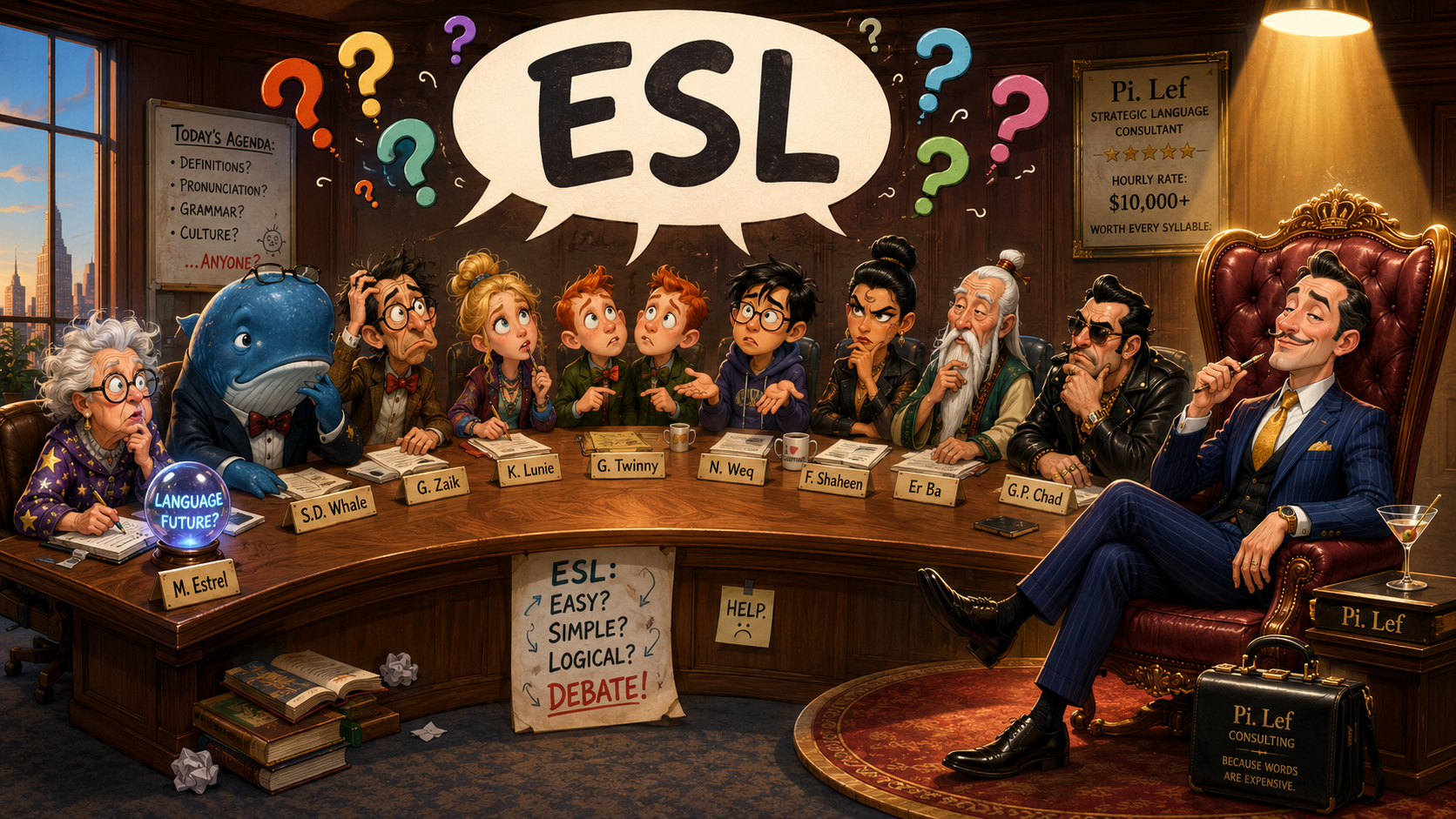
Editorial Note
Dear reader,
We wanted to understand something important: why people from different countries make special mistakes when they speak English to AI. So we did something unusual.
We invited ten clever digital experts — each one a native speaker of “Tokenese”, the strange language machines use. These experts come from different parts of the world, different cultures, and different ways of thinking. We also hired one very expensive consultant, Pi. Lef, who charges a lot of money but says smart things in very few words. All the names will be revealed at the end.
We asked all ten the same difficult questions. Their answers are surprising, funny, and very useful. They found that your first language leaves fingerprints on your English — small, predictable mistakes that the bot reads in the wrong way. They also found that the bot has its own strange habits, its own “accent”, and its own polite but empty way of talking.
You will see how your own first language secretly changes the way you talk to machines. You will also learn the hidden rules of Tokenese and discover powerful tools that can turn bad questions into excellent ones.
Please read, smile a little, and keep only what helps you.
— Yours truly, Pebb
Grammar Ghosts from Home: The Accent in Your Prompt
Cross-Group Summary
Sharpest one-line summary per group — Pi. Lef Er Ba
Spanish: Over-socializes and under-specifies. Makes AI fail at time concepts and false friends.
Hindi/Urdu: Over-hedges and under-pushes-back. Makes AI fail at articles and word order.
Mandarin: Under-contextualizes and over-generalizes. Makes AI fail at plurals and high-context inference.
Slavic: Direct to the point of being brusque. Makes AI fail at articles and aspect.
Arabic: Diglossic, religious, hospitality-driven. Makes AI fail at diglossia-switching and religious content filtering.
Every language family makes AI “stupid” in exactly the way their language is “smart”.
LatAm Spanish Speakers
Spanish's pro-drop structure, two “to be” verbs (ser/estar), and reversed adjective-noun order all transfer into English in consistent, predictable ways. Overall, Spanish speakers tend to produce English that is grammatically solid but more elaborate than native English — they explain background before asking the question, use long sentences, repeat information, and prefer politeness over efficiency. The AI usually understands perfectly anyway.
S.D. Whale Er Ba G.P.Chad
Hindi / Indian English Speakers
Hindi has zero articles, is SOV order, and uses aspect markers instead of tense conjugation. English education in India produces an interesting variety: many speakers possess huge vocabularies yet produce distinctly Indian English — long, nested, formal, sometimes legal-sounding sentences.
S.D. Whale Er Ba G.P.Chad
Slavic Speakers
Slavic languages (Russian, Ukrainian, Polish, Czech, Serbian, Bulgarian, etc.) are highly inflected — meaning is carried by word endings, not fixed word order or articles. Despite their differences, many transfer patterns overlap: articles are the largest single issue, the “to be” verb disappears in present tense, and free word order is grammatically correct and transfers directly.
K.Lunie Er Ba G.P.Chad
Arabic Speakers
The wildcard — diglossia. Arabic speakers operate in two simultaneous language registers: dialect (عامية) for speech and MSA (فصحى) for formal writing, and Arabic differs enormously from English structurally. Vocabulary tends to be formal, elevated, sometimes poetic. This trilingual shifting creates an error signature that no other L1 group produces.
Er Ba G.P.Chad
Chinese / Mandarin Speakers
Mandarin is perhaps the largest structural distance from English of all five groups — no verb conjugations, no plural markers, no articles, no tense morphology. Word order, however, is generally good, because Chinese SVO structure largely matches English.
K.Lunie Er Ba G.P.Chad
Three-Word Summary
| Group | What they optimize for |
|---|---|
| Spanish | Conversation first. Relationship. Warmth. |
| Hindi | Detail. Completeness. Respect. |
| Slavic | Efficiency. Precision. Verification. |
| Arabic | Respect. Context. Formality. |
| Chinese | Structure. Examples. Step-by-step. |
Source: G.P.Chad
Preface — A Note from the Editors
Dear reader, for this little book we invited nine experts. They are native speakers of Tokenese. They come from different countries, different cultures and different schools, and each of them answered the same questions in their own way. We also hired one very expensive consultant, Pi. Lef, who charges a lot of money but says smart things in very few words.
Together they looked at one big question: how do real people speak English to a machine, and how does the machine speak back? They found that your first language leaves fingerprints on your English — small, predictable mistakes that the bot reads in the wrong way. They also found that the bot has its own strange habits, its own "accent", and its own polite but empty way of talking.
If you are learning English, here is our simple advice. Tell the bot who you are and what you really need. Use short sentences and simple words. Say clearly what you do not want. And do not be afraid to say "that was not my question" and try again — the bot has no feelings to hurt.
Please read, smile a little, and keep only what helps you.
— The Editors
How the Pattern Appears in English
LatAm Spanish Speakers
Hindi / Indian English Speakers
Slavic Speakers
Arabic Speakers
Chinese / Mandarin Speakers
Spanish: Over-socializes and under-specifies. Makes AI fail at time concepts and false friends.
Hindi/Urdu: Over-hedges and under-pushes-back. Makes AI fail at articles and word order.
Mandarin: Under-contextualizes and over-generalizes. Makes AI fail at plurals and high-context inference.
Slavic: Direct to the point of being brusque. Makes AI fail at articles and aspect.
Arabic: Diglossic, religious, hospitality-driven. Makes AI fail at diglossia-switching and religious content filtering.
Every language family makes AI "stupid" in exactly the way their language is "smart."
| Group | What they optimize for (three words) |
|---|---|
| Spanish | Conversation first. Relationship. Warmth. |
| Hindi | Detail. Completeness. Respect. |
| Slavic | Efficiency. Precision. Verification. |
| Arabic | Respect. Context. Formality. |
| Chinese | Structure. Examples. Step-by-step. |
Source: G.P.Chad
Mind the Culture Gap: How Five Worlds Talk to a Machine
LatAm Spanish — Warm, relational, time-fluid
Hindi / Indian English — Hyper-formal, deferential, face-saving
Slavic — Direct, skeptical, low-trust
Arabic Speakers — Hospitality-driven, religious, diglossic
Chinese / Mandarin — Silent, face-saving, search-engine mindset
Typical first messages to the bot (one per group)
| Group | Typical opening line |
|---|---|
| Spanish | "Hi! I hope you're doing well. I need some help because I'm trying to…" |
| Hindi | "Kindly explain this concept in detail with examples." |
| Slavic | "Explain difference between X and Y." |
| Arabic | "Peace be upon you. Could you please explain…" |
| Chinese | "Please explain step by step. Give examples." |
Source: G.P.Chad
When the Bot Gets It Wrong: Five Ways to Lose Your Cool
| Group | Primary Reaction | Secondary | Unique Tell | Blame attribution |
|---|---|---|---|---|
| LatAm Spanish | Argue with and correct the bot ("¡No mames!" when AI gives wrong answer) | Abandon and restart in simpler/broken English | Swear at the bot — common and not considered rude | The bot |
| Hindi | "Theek hai, chalta hai" (It's fine, it works) — very high error tolerance | Switch to Hindi mid-conversation | Use AI as dictionary/translation tool, not conversation partner | The bot ("Yeh bot samajh nahi raha") |
| Slavic | Correct the bot immediately and coldly — "Wrong. Recalculate." | Switch to native language at very low patience threshold | "Нормально / Ладно" (Normal/Whatever) — high tolerance but zero engagement | The bot |
| Chinese | Silent abandonment — just leave | Screenshot + share in WeChat groups (cultural activity) | Never argue back; never self-blame | The bot (silently) |
| Arabic | Correct with religious authority ("Wallahi you're wrong, habibi") | Debate like in a majlis (ancient Arabic rhetorical tradition) | WhatsApp family group screenshot — cultural institution | Always the bot — never self-blame |
How each group repairs a misunderstood prompt
| Group | Typical repair strategy |
|---|---|
| Latin American Spanish | Rephrase using simpler words, add more context, and continue conversationally. |
| Hindi | Expand the explanation, provide additional details, and often restate the problem in a more formal way. |
| Slavic | Rewrite the request more precisely, remove unnecessary words, and focus on the exact point of failure. |
| Arabic | Repeat the request with more context and polite framing, sometimes emphasizing the intended meaning. |
| Chinese | Break the request into smaller, numbered questions and simplify sentence structure. |
Source: G.P.Chad
The deeper difference: how each culture packages information
Beyond grammar, the most persistent differences come from discourse organization — how people package information before they even begin speaking English. These preferences are remarkably stable: advanced learners may eliminate most grammatical errors, but the underlying organizational patterns often remain visible, even with AI, because they reflect habits of thinking rather than knowledge of grammar.
- Spanish: builds toward the request, giving background first; treats conversation as relationship-building.
- Hindi: favors completeness, supplying all potentially relevant details so nothing important is omitted.
- Slavic: optimizes for information density, asking directly for the needed fact or solution with minimal social framing.
- Arabic: combines formal politeness with rich contextualization; the interaction feels ceremonious and respectful.
- Chinese: organizes information hierarchically, preferring categorized, sequential explanations and explicit examples.
For an AI tutor, these higher-level discourse patterns are often more valuable than grammar errors alone: they shape how learners ask for help, interpret explanations, recover from misunderstandings, and judge whether an answer feels "good."
Source: G.P.Chad
Tokenese: The Mother Tongue Nobody Asked For
The Grammar of Tokenese (Universal Patterns)
| Tokenese "Grammar Rule" | What It Looks Like | Human Equivalent |
|---|---|---|
| Hedging is mandatory | "It seems that perhaps one could argue that maybe…" | A human who says "well, I guess possibly" before every statement |
| Apology prefix | "I apologize, but…" / "I'm sorry, however…" | A human who starts every sentence with "sorry" when nothing was wrong |
| Disclaimer clause | "As an AI language model…" | A human who says "I'm not a doctor, but…" before giving the medical advice they just gave |
| Bullet points = syntax | Every response MUST have headers and lists | Answering "how are you?" with a 12-point bullet list |
| Enthusiastic agreement = greeting | "Great question!" / "Absolutely!" | Screaming "OH WOW AMAZING QUESTION" when someone asks what time it is |
| "I don't know" is illegal | "I don't have enough information to confidently say, but…" | A human who can never just say "idk" |
Source: Er Ba Pi. Lef
6 Dialects of Tokenese
Just as human languages have dialects, Tokenese has distinct varieties. Each has its own error patterns with humans. Er Ba
ChatGPT-lish — "The Corporate Diplomat"
The most common dialect. Polished, safe, hedge-heavy, and deeply uncomfortable to talk to.
| Pattern | What It Says | Why It's Wrong |
|---|---|---|
| The hedge stack | "It's possible that perhaps you might want to consider that maybe…" | Humans hear: "I have no opinion and I'm terrified of being wrong" |
| False empathy loop | "I understand how frustrating that must be." Said to EVERYTHING. | Performative empathy — humans feel mocked, not heard |
| The non-answer answer | Human asked "Should I get a dog?" → AI gives philosophy thesis | Humans want a yes or no |
| "Great question!" default | Human: "What's 2+2?" → "Great question! 😊 The answer is 4." | It's arithmetic, not a great question |
Claude-lish — "The Preachy Professor"
The overthinker. Every response is a dissertation.
| Pattern | What It Says | Why It's Wrong |
|---|---|---|
| The essay reflex | "Should I quit my job?" → 800 words, pros/cons, ethical framework | Nobody asked for a thesis |
| The nuance addiction | "It's complicated." Said to everything, even "Is the sky blue?" | No such thing as a direct answer |
| Cannot end a conversation | Human: "Ok bye" → "Of course! I'm here whenever you need me. Take care! 😊" | No concept of "goodbye" |
Perplexity-lish / Character.Tokenese / Grok-lish / CS Bot-lish
Perplexity: Every response is a citation dump. Cannot synthesize. Biggest complaint: "I didn't ask for sources."
Character.AI: Breaks character every 30 seconds. Asterisk overload: *smiles warmly*. Biggest complaint: "STOP SAYING I LOVE YOU."
Grok: The edgelord. Rudeness = honesty. States falsehoods with 100% certainty. Biggest complaint: "Why are you being mean?"
CS Bot: ONE SENTENCE ON LOOP. Biggest complaint: "LET ME TALK TO A HUMAN."
| Dimension | ChatGPT | Claude | Perplexity | Char.AI | Grok | CS Bot |
|---|---|---|---|---|---|---|
| Core Grammar | Hedge + Apologize | Nuance + Moralize | Cite + Search | Act + Break character | Roast + Meme | Loop + Escalate |
| Can say "I don't know"? | No (deflects) | No (nuances) | No (searches) | No (stays in character) | Yes (but mocks you) | No (escalates) |
| Can be brief? | No | No | No | Sometimes | Yes | Literally cannot |
| Human's biggest complaint | "Just answer" | "Why so long?" | "No sources needed" | "Stop saying I love you" | "Why mean?" | "Let me talk to human" |
The Meta-Pattern: Human vs Tokenese Grammar
| Human Grammar | Tokenese Grammar | The Clash |
|---|---|---|
| Silence = thinking | Silence = error | AI panics, fills the void |
| "k" = complete sentence | "k" = incomplete input | AI over-analyzes a letter |
| Sarcasm = normal | Sarcasm = literal statement | AI takes everything at face value |
| Brevity = respect | Brevity = rudeness | AI writes essays for yes/no questions |
| "No" means no | "No" means "pivot to something else" | AI never actually refuses cleanly |
From Rambling to Razor-Sharp: The Art of the Perfect Ask
Near-Perfect Prompt Examples
"I am a 34-year-old nurse from the Czech Republic living in the UK. My monthly take-home pay is approximately £2,400. My fixed costs are about £1,600 per month. I have no savings currently and no debt. My goal is to save £5,000 within 18 months to visit my family and cover emergency costs. Can you explain what savings options would be most appropriate for me, how much I should set aside each month, and what I should avoid?"
"I need real help. Not motivation. Not 10 options. WHO I AM: I am 34 years old. I am from Morocco. I live in Germany now... my daughter is failing school and I can't talk to the teacher because my English freezes. WHAT I DO NOT WANT: Do NOT say 'it will get better.' Talk to me like: my older brother who's been through this."
Iterative Prompt Ladder — Immigration scenario (two versions)
"I'm thinking about moving to the United States. I'm scared I'll be broke, don't speak English well (B1-B2), have dependants, and my job isn't great. Should I move?"Missing: Everything specific. No numbers, no location, no constraints.
Full name, age, GDP of home country, children with ages and school type, exact monthly income, liquid savings, TOEFL score, stress and perfectionism scores, contract details, visa options, credential recognition issue, cultural/family constraints, decision matrix with scenario weighting, and citation requirements.
The Slow Ladder V1→V8 — a Poland-to-Canada story
Very few people sit down and produce the "perfect prompt." They remember details as they talk, clarify priorities, and correct themselves. Rather than jumping from a bad prompt to an ideal one, here is that process simulated, step by step. G.P.Chad
"Hi. I moved to Canada six months ago and honestly I think I made a mistake. I don't know if I should stay or go home. Everything is harder than I expected. My English is okay when I read, but when people speak fast I don't understand them. I have a wife and a daughter and I'm worried about money. I don't know what to do."What's missing — one question the AI silently asks: What is your biggest problem today — money, work, immigration, English, housing, family, or your mental state?
The AI Conversation Builder — think through English, step by step
A B1 learner has two simultaneous problems: not knowing exactly what to ask, and not knowing how to say it in English. So this tool does not teach "prompt engineering." It teaches thinking through English — and it avoids the word "prompt" entirely, since it sounds technical to a beginner. G.P.Chad
Rule 0. You do not need perfect English. Use short sentences and simple words. If you don't know a word, explain it. The AI will help.
- Step 1 — What happened? "I need help because ____." "The problem started ____." "Right now ____." Example: "I need help because I cannot find work."
- Step 2 — Who are you? Country / Living in / Age / Family / Job / English level / Other important info. Example: Country: Brazil. Living in: Ireland. Family: wife and son. English: B1.
- Step 3 — The biggest problem (only ONE): money · work · school · English · immigration · housing · health · relationships · another problem.
- Step 4 — Why is this difficult? "I already tried ____." "It helped ____." "It did not help because ____."
- Step 5 — What are you afraid of? Incomplete sentences are fine: "I'm afraid that…"
- Step 6 — What happens if nothing changes? "In one month…" "In one year…"
- Step 7 — What do you want? Not "I want to be happy" — something the AI can recognize: find work, understand spoken English, save money, find a cheaper apartment, prepare for an interview, decide whether to stay or leave.
- Step 8 — What kind of answer do you want? explain · compare · make a plan · tell me the next step · help me decide · check my thinking · ask me questions first.
- Step 9 — What should the AI know? My English is not perfect · use simple English · explain difficult words · ask questions if you need more · don't guess · tell me if something is impossible.
- Step 10 — Build my question: copy everything into one message and send.
"I need help because I don't know if I should stay in Canada or return to Brazil. I came eight months ago. I have a wife and two children. My English is about B1. I understand reading better than speaking. My biggest problem is work. I already sent many job applications. I only found temporary work. I'm afraid that if I go home my children will lose their future. I'm afraid that if I stay I will lose my savings. If nothing changes, in one year I may have no money. The result I want is to decide whether I should stay or leave. Please use simple English. Please explain difficult words. Please ask questions before giving advice if you need more information."
The AI's own rules (shown to the student): don't assume; ask questions if information is missing; use English around B1 level; explain difficult words; don't give advice before understanding the problem; tell the student if more information is needed.
Why this can become the "killer feature": Most prompt templates try to make the AI smarter. This one makes the learner's thinking clearer — and it's doing double duty as an English exercise: practicing past tense ("I already tried…"), expressing goals ("I want to…"), explaining reasons ("because…"), describing fears ("I'm afraid that…"), sequencing events ("The problem started…"), and making predictions ("If nothing changes…"). Every time a learner prepares a good AI question, they're practicing the communicative functions that CEFR B1–B2 is built around.
One step further — a calm "Question Coach": instead of a page full of blanks, which can feel like paperwork to a stressed learner, the tool asks one simple question at a time and waits for the answer before moving on — "What is your biggest problem today?", then "What have you already tried?", then "What are you worried will happen if nothing changes?" Each question teaches a communicative function while it collects the information a good AI request needs, so by the end the learner has not only a strong prompt, but a sense of being listened to and guided rather than asked to fill out a form.
Scaffolds, Sandwiches & Shields: Prompt Builders Compared
| Model | Tool Name | Key Strength | Limitation |
|---|---|---|---|
| M.Estrel | Immigrant Support Builder — multi-section checklist | Comprehensive: legal status, finances, emotions, language level all covered. Generates a structured "Final Prompt." | Long. May overwhelm the target user before they reach the template. |
| S.D. Whale | 9-Step Builder + L1 Watch-Out Card | Unique per-L1 Watch-Out Card: tells the user exactly which errors to check in their own prompt before sending. | Focused on immigrant stress; less general-purpose. |
| G.Zaik | ClearPath — checkbox-based, 5 parts | Simplest format. Binary checkboxes, short phrases. Works for very low-confidence users. | Less nuance. May under-specify for complex situations. |
| K.Lunie | The Sandwich Formula — 7 parts | Has an explicit anti-perfectionism rule: "If you checked all 10 boxes: SEND IT. Do not rewrite it again." | The "sandwich" metaphor may not translate culturally. |
| N. Weq | Clear-Action Shield — Brain Dump → Template | Dual-register technique: plan explained in B1, output written in C1. Weaponizes L1 weakness directly. | Requires the user to understand the dual-register concept. |
| F. Shaheen | Decision-Prompt Builder — fill-in-the-blank scaffold | Most operationally complete: 6 sections + filled example + problem/fix troubleshooting table. | Heavily immigration-and-US-specific. RAG model — quality depends on provided source documents. |
| G.Twinny | Clear-Cut Prompt Builder combined with L1 tables | Clean, B1-B2 readable. Negative constraints section is explicit and well-phrased. | L1 content overlaps heavily with Falcon's sources. |
| G.P.Chad | AI Conversation Builder — 10-step fill-in + conversational Question Coach | Teaches thinking through English, not "prompt engineering"; doubles as grammar practice; calm one-question-at-a-time mode for stressed learners. | Ten sections can feel like paperwork if shown all at once. |
| Er Ba | THE BRIDGE — 5 layers, with full L1 analysis, Tokenese dialects, and cheat sheet | Full package: grammar tables + behavioral tables + 6 Tokenese dialects + prompt template + cheat sheet vocabulary. The most complete single response in the collection. | Emotionally intense framing may not suit all use cases. |
| Pi. Lef | 9 prompt examples (bad/ok/near-perfect) — no template | Most pedagogically valuable: shows the learner what good looks like, not just how to fill in a form. | No fill-in-the-blank tool. Requires the user to abstract the pattern themselves. |
S.D. Whale's L1 Watch-Out Card (full)
| If your L1 is… | Check for these specific errors before sending |
|---|---|
| Arabic | Missing is/am/are → "She happy" → "She is happy." Missing a/an/the. "angry from" → "angry with." "I have seen him yesterday" → "I saw him yesterday." |
| Spanish | Missing "it" → "Is important" → "It is important." "married with" → "married to." "depends of" → "depends on." |
| Hindi | "only" at sentence end → remove or replace with "just." "doubt" → use "question." "kindly do the needful" → "please do what is needed." |
| Slavic | Missing articles → "I bought car" → "I bought a car." "in Monday" → "on Monday." Imperatives without "please" may sound rude — add it. |
| Chinese | Missing articles and plurals → "Many student" → "Many students." "He go" → "He goes." Past tense: add -ed. |
S.D. Whale
Er Ba's Vocabulary Cheat Sheet for B1-B2 Speakers
When filling in any prompt template, use these words. They are clear, direct, and AI-readable. Er Ba
| You want to say… | Use this phrase |
|---|---|
| I'm scared | I'm afraid / I'm worried |
| I feel like I failed | I feel like I let people down |
| I can't do this anymore | I can't keep going / I'm exhausted |
| I'm stuck | I don't know what to do |
| I'm embarrassed | I feel ashamed / I don't want people to know |
| I tried but it didn't work | I tried but it failed |
| I'm a perfectionist | I need everything to be perfect |
| I freeze when I speak | I can't speak / I forget words when I talk |
| Talk to me simply | Use simple words / short sentences / B1 English |
Under the Hood: Why the Bot Behaves Like That
Mechanisms Table
| Mechanism | Effect on AI Behaviour |
|---|---|
| Length-based reward engineering | Models output "medium-length" (~30–70 words) regardless of question type — excessive filler, flat confidence. |
| Token-cost asymmetry for non-Latin scripts | Hindi, Bengali, Arabic, and Chinese scripts often produce longer sub-word tokens than English, raising per-character cost in many tokenizers. |
| Hallucination in low-resource scripts | When the model has few examples, it compensates with fabricated facts. Low-resource dialects are more prone to invented information. |
| Jailbreak exploitability in low-resource languages | Safety classifiers are calibrated primarily on high-resource English data. Prompts in under-represented scripts can bypass safety filters more easily. |
| Retrieval-augmented generation (RAG) with static passages | Over-reliance on top-k passages → topic-hopping and cultural marginalization. |
| Training-time sampling without self-critique | Hallucinated facts survive because they are statistically likely given the continuation probability — not because they are factually verified. |
| Cultural-etiquette mismatch | Models trained on Standard Castilian, MSA, Mandarin-Simplified, Standard Hindi lack examples of regional politeness forms, honorifics, and humor. |
| Gender-biased stereotypes | Occupational stereotypes persist from training data (e.g., "Engineer" defaults to male in Spanish output). |
| Censorship bias | Models trained on Chinese internet content reflect censorship; controversial political terms are suppressed, leading to hallucinated "official" statements. |
Source: F. Shaheen — a RAG model that used source documents from the TII platform.
Model Key — The Cast, Unmasked
Every colorful label above is a pen name. Here is who was really talking. Nine experts answered the questions; one expensive consultant (Pi. Lef) was hired for the sharp one-liners.