local speech analysis · open source
phonetic
mirror
Phonetic Mirror doesn't grade your voice. It gives you a way to see it.
Compare your voice with a reference. See the difference. Follow the patterns and notice subtle changes in your pronunciation.
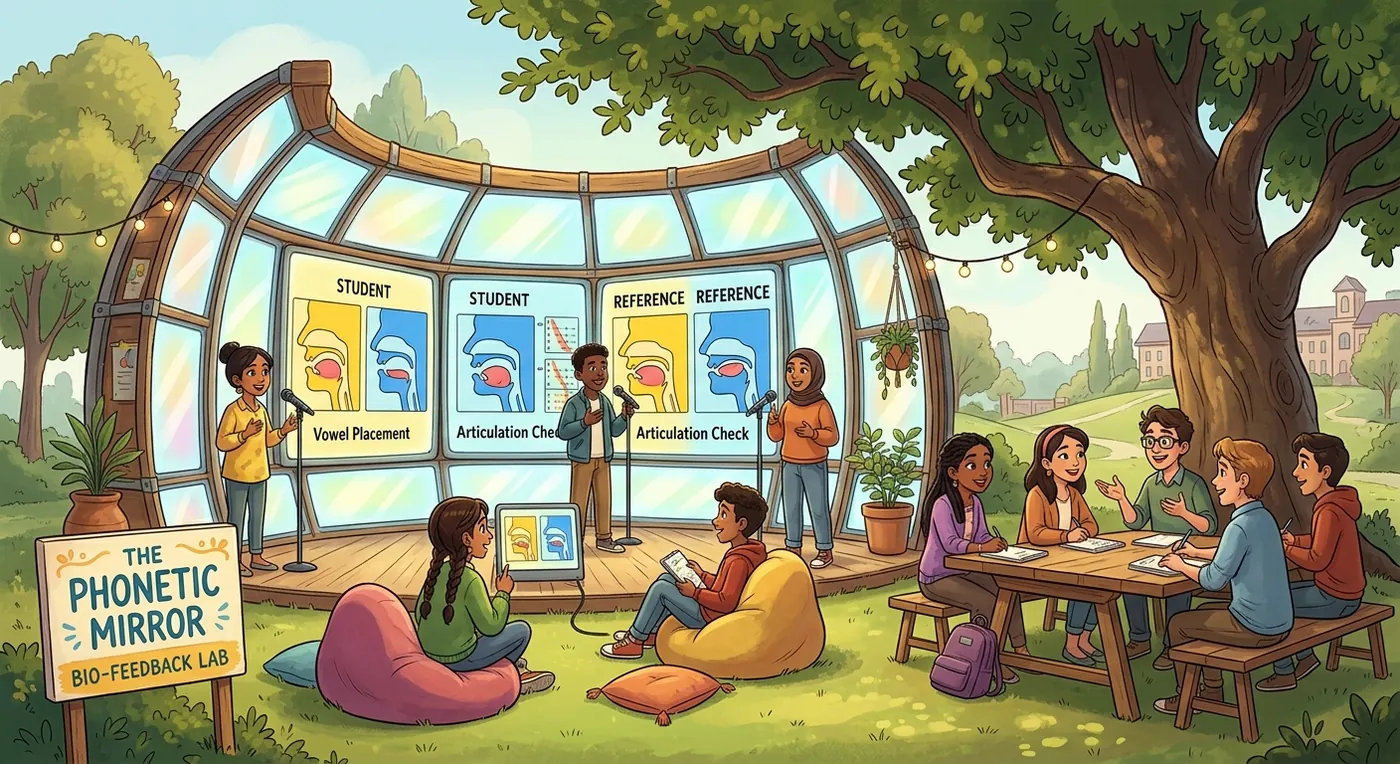
reference learner
once upon a time in the Kingdom of Academia…
Ella wanted to show her students the sounds they could not hear. An old laptop, a night janitor, a wizard, and a lobster on the Pi carried the idea somewhere improbable.

“A little off” is hard to practice.
Form a closure with the tongue tip at the alveolar ridge while lowering the velum and maintaining voicing.
Good instruction still needs a way back into the learner's own voice.
“I'm not a phonetician. So… what am I doing wrong?”
More than vowels.
Five focused desktop tools ask different questions of the sound.
- 01
Vowels
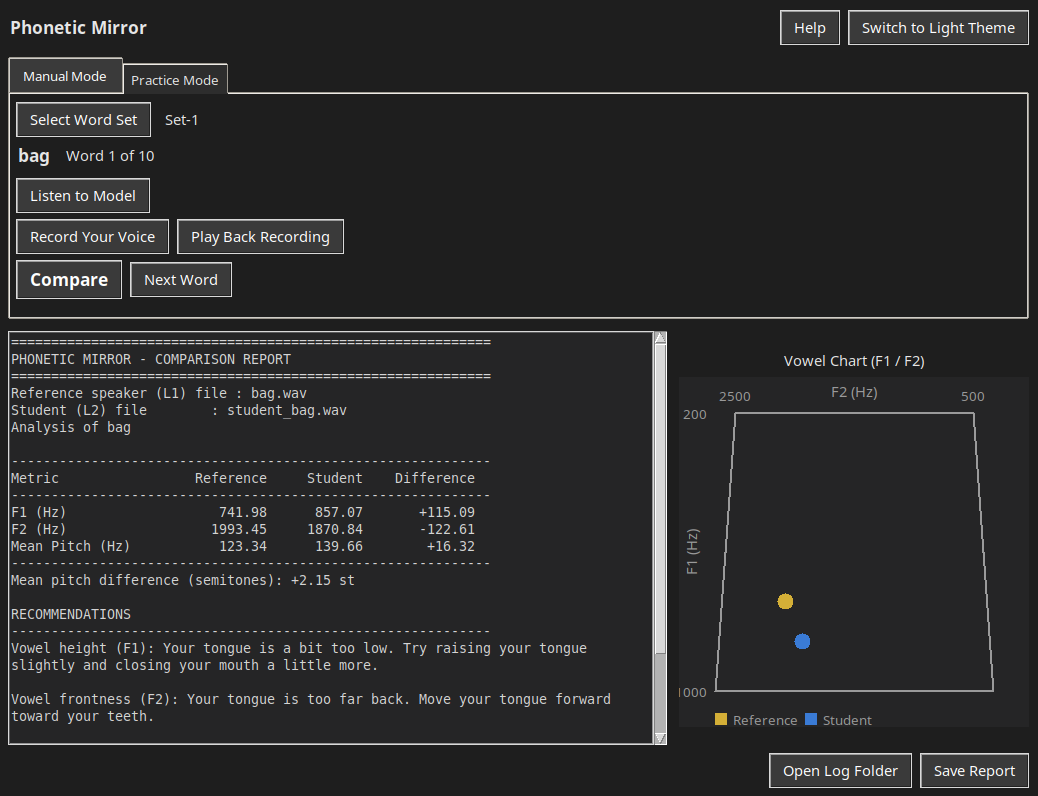
Compare F1 and F2 estimates, pitch, and intonation contours.
formants · pitch · contour - 02
Stops
Compare detected release timing, Voice Onset Time, and formant estimates near vowel onset.
/p t k b d g/ - 03
Fricatives
Compare estimated spectral centre of gravity and mean intensity for detected frication.
/s z f v ʃ/ - 04
Nasals & Liquids
Observe selected formant and intensity patterns in English nasals, /l/, and /r/.
/m n ŋ l r/ - 05
Progress Viewer
Filter saved session logs and follow selected observations across attempts.
patterns over time
Know your “partner.”
A reference is a chosen comparison point—not universal correctness or the one proper English voice. Speakers naturally differ.
Phonetic Mirror uses selected acoustic measurements to help make differences visible. Uses Praat for acoustic speech analysis.
- F1 estimated first-formant frequency
- F2 estimated second-formant frequency
- F0 estimated fundamental frequency and pitch contour
F1 and F2 are acoustic resonance estimates, not literal measurements of tongue position. No single metric tells the whole story.
A reference should have a context.
- language / variety
- US English
- reference ID
- US-01
- word / target
- see · /s/
- reference type
- curated
- conditions
- controlled
- licensing
- documented source
This example does not describe an existing recording. Metadata cannot rescue poor audio; it makes a deliberately selected reference more transparent.
A reference is a choice. Make the choice visible.
Patterns over scores.
Repeated attempts can reveal change across sessions, recurring patterns, and movement toward—or away from—a chosen reference. The point is not to compress a voice into one artificial score.
The progress line matters more than the finish line.
The picture is useful. The measurements behind it can be useful too.
Saved logs can be reviewed, filtered, compared, analyzed separately, and prepared for appropriate educational or research reuse.
Raw data is not automatically anonymous. When preparing a dataset for reuse, measurements can be separated from identifying information or deliberately pseudonymized.
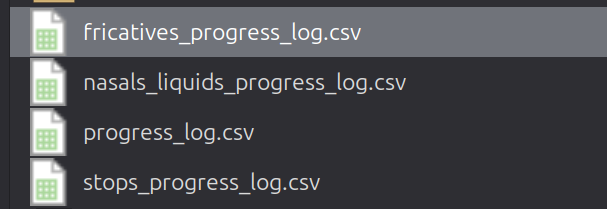
Your voice doesn't need a trip to the cloud.
Open, yet private by design.
That is a design choice, not an absolute privacy or security guarantee. Inspect the source and use the software in an environment appropriate for your recordings and data.
Look inside.
Phonetic Mirror is an early public release for Linux, written in Python. Uses Praat for acoustic speech analysis. The source is available under the GNU GPL v3.
- platform
- Linux desktop
- input
- WAV audio
- analysis
- Praat, installed separately
- license
- GPL v3
Praat is a separate project. Phonetic Mirror is not affiliated with or endorsed by the Praat team.
The story crosses into the real world here.
When the fairy tale became software.
A launcher and five working local tools, still early, still being tested. This is a working desktop suite, not a browser demo.
Where will it go?
That depends on what happens next — who uses it, who tests it, who teaches with it, who helps improve it, and whether there is enough support to keep building.
Maybe it stays a small open-source tool. Maybe it grows into an Open Phonetic Lab. This fairy tale does not have an ending yet — and every now and then, the right people can make something improbable happen.